

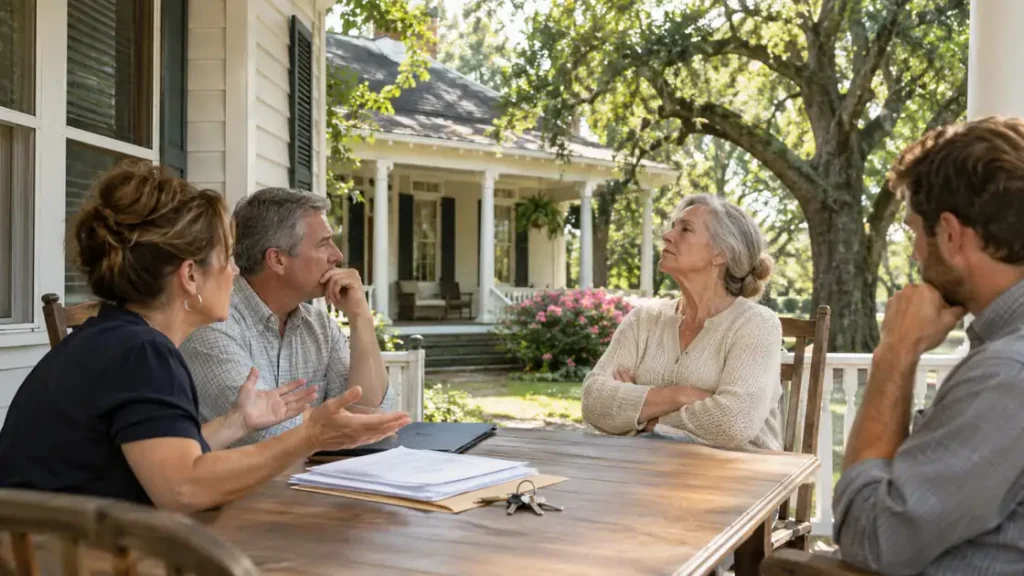
A parent leaves a house to several children. Most want to sell, but one sibling wants to keep the family home. When one heir refuses to sell inherited property, the answer depends less on family votes than on who legally owns the house and whether probate is still underway.
In Alabama, one co-owner generally cannot sign away everyone else’s interest in a voluntary sale. Families can negotiate a buyout, agree to keep the property, or consider a court partition action. An executor’s authority to sell estate property is a separate question. Here is how to identify the correct route and avoid signing an agreement that cannot close.
Can You Sell an Inherited Alabama House Without Every Heir Agreeing?
Not usually through an ordinary voluntary sale of the entire home if all heirs already own separate undivided interests. Every interest needed for clear title must be conveyed by its owner or through valid legal authority. A court-approved estate sale or partition order can change that result, so confirm ownership before counting signatures.
| Sale route | Who can authorize it | Main limitation |
| Voluntary sale of the house | All required titled owners | One owner cannot convey another owner’s share |
| Sale of a fractional interest | Owner of that interest | Buyer receives only that undivided share |
| Estate or court-authorized sale | Proper representative or court process | Authority, orders and notices must be satisfied |
Selling the Whole House Versus Your Ownership Share
An heir who owns a 25% undivided interest may be able to transfer that interest, subject to applicable restrictions. But the buyer becomes a cotenant, not the sole owner of the property. Finding a buyer for a partial interest can be difficult because it does not promise exclusive possession or control of the house.
When an Executor or Administrator Controls the Sale
During probate, heirs may be beneficiaries without having authority to execute an estate deed. Review the will, appointment papers, probate orders and recorded title. Under Alabama Code §43-2-844, a personal representative ordinarily needs prior court approval to sell estate land unless the will expressly authorizes the transaction. Other estate-sale provisions may also apply. Have probate counsel establish the correct authority before accepting a binding offer.
Why Alabama Heirs-Property Rules Matter
“Heirs property” has a specific meaning under Alabama’s Uniform Partition of Heirs Property Act, Chapter 6A of Title 35. It is not simply a label for every inherited home. The statute concerns qualifying family-related tenancy-in-common ownership and supplies safeguards when a partition action is filed.
Determine Who Legally Owns the House
Start with the last recorded deed, death certificate, any will, probate file and information identifying successors. Check mortgages, judgments and tax balances. Inheritance chains can become complicated when an heir dies without recording a deed or an estate was never fully administered. A title examination helps establish ownership percentages and potential missing parties.
Does a Majority Vote Let the Heirs Sell?
No automatic majority-rule power allows three out of four cotenants to transfer the fourth person’s share through a private deed. Even when a family collectively owns 75%, the remaining 25% remains an ownership interest. A majority may agree to seek legal relief, but the court must apply the governing statute and facts.
Five Options When One Sibling Refuses to Sell
Before filing a lawsuit, compare what each heir actually wants. Someone hoping to live in the house may accept a buyout, while a sibling seeking cash may prefer a fixed payment date. Put proposals in writing and account for repairs, debts and current property expenses.
1. Agree on a Fair-Market-Value Buyout
Obtain an independent appraisal or other credible valuation, verify the shares and calculate the amount to purchase the departing heir’s interest. For example, if the family agrees on a hypothetical net property value of $240,000 and a sibling owns 25%, the starting share calculation is $240,000 × 25% = $60,000. Debts, reimbursements and negotiated terms can change the actual settlement. Financing and a properly recorded deed are still necessary.
2. Sell by Mutual Agreement to an Agent or Cash Buyer
If everyone agrees, an agent can expose the home to the market, or the family can compare a direct offer. Judge each proposal by net proceeds, inspection conditions, fees, financing and closing risk. Cash does not replace an unwilling owner’s signature, a probate order or a clean title.
3. Keep the Home Under a Written Co-Ownership Agreement
An agreement can identify who occupies the property, collects any rent, pays taxes and insurance, approves repairs and decides when a future sale may occur. A written exit or buyout procedure is especially useful when several family members live out of state. Counsel should draft terms suited to the title arrangement.
4. Consider Mediation Before Litigation
A mediator can help heirs compare a sale, a payment plan and continuing ownership without forcing an immediate court fight. Bring a valuation, expense records and written offers. Each person should understand that mediation produces a binding outcome only through the appropriate agreement and formalities.
5. Ask a Court for Partition When Negotiations Fail
A cotenant may seek partition, asking a court to resolve ownership deadlock. Filing a partition case does not mean the property automatically goes to auction. If the house qualifies as statutory heirs property, additional valuation, buyout and physical-division safeguards govern the court’s choices.
How an Alabama Partition Action Works
A partition action is a legal process for resolving shared ownership. Alabama’s ordinary partition provisions and its special heirs-property rules can lead to different procedures. The court considers the ownership interests and whether the property can fairly be divided or must be sold.
Step 1: Confirm Ownership and Whether Chapter 6A Applies
The lawyer identifies all cotenants and necessary parties, reviews any agreement controlling partition, and determines whether the Chapter 6A definition is met. Family history alone does not prove eligibility; ownership percentages and how interests were acquired matter.
Step 2: Valuation and the Other Heirs’ Buyout Opportunity
For qualifying heirs property, the court determines value under the statute. When a cotenant requests partition by sale, Alabama Code §35-6A-7 generally gives eligible nonselling cotenants an opportunity to purchase the interests of those requesting sale. Court notices, elections and payment deadlines are specific; informal promises do not replace them.
Step 3: Partition in Kind Versus Partition by Sale
Partition in kind divides land into separate parcels. Section 35-6A-8 generally favors that approach for qualifying heirs property unless division would cause great prejudice under the statutory factors. A single house on a small lot may be difficult to divide physically, but that does not make a forced sale automatic.
Step 4: If the Court Orders Sale
Under §35-6A-10, a court can select an open-market sale, sealed bids, public auction or private sale, depending on what best serves the cotenants as a group. The court supervises the process, while liens, case expenses and ownership shares affect what each party ultimately receives.
Cost, Delay and Family Considerations
Partition can involve service of process, valuations, attorney fees and court hearings. Duration and cost vary; there is no reliable universal Alabama timetable. Before filing, compare an attorney’s case-specific estimate with the cost of a voluntary buyout or negotiated sale.
A Step-by-Step Plan to Sell an Inherited House in Alabama
Before Listing: Verify Title, Probate Status and Liens
Order a title review. Gather the deed, will, probate orders, appointment documents, mortgage statement, tax bills and all known judgments or claims. Identify who must sign. If an heir cannot be located, ask counsel what notices or legal representation may be required rather than leaving that interest out.
Obtain an Appraisal or Market Analysis
Use a defensible valuation as a common starting point. Review roof and structural condition, occupancy, repair estimates and the costs of keeping the house insured and maintained. An asking price is not the same as a guaranteed net amount for the family.
Document Agreement, Execute the Sale and Allocate Proceeds
Record the agreed buyer, purchase price, deadlines, repairs, cost allocations and signatures in appropriate written documents. A closing attorney can confirm deeds, releases and distribution instructions. Keep the final settlement statement; the amount available to heirs may be reduced by liens, sale expenses, estate obligations or court directions.
What If the Refusing Heir Lives in the House?
Occupancy creates additional questions about maintenance, utilities, access and possible accounting between cotenants. A resident heir does not automatically lose ownership because other heirs want a sale. Equally, living in the house does not grant authority to exclude every other owner in all circumstances.
Set Rules for Access, Maintenance and Expenses
Try a temporary written arrangement covering insurance, taxes, necessary repairs, inspection access and who pays current bills. Document major payments and avoid assumptions about whether rent is owed to the other owners. Alabama counsel can assess possession and reimbursement issues.
When Communication or Signatures Are Missing
Do not change locks, remove belongings or attempt self-help eviction based only on a family vote. When someone cannot be found or will not respond, a lawyer can review lawful notice, probate and partition procedures. A missing signature is a title problem to resolve, not an invitation to sign on someone’s behalf.
Taxes and Net Proceeds When Siblings Sell
Receiving inherited real estate and later selling it are different tax events. For federal income-tax purposes, inherited property generally takes a basis tied to its fair market value at death, subject to exceptions and adjustments. The actual seller, improvements, expenses and use of the property may affect reporting.
Example: Inherited Value Versus Sale Price
Assume a hypothetical supported date-of-death value of $200,000 and a later sale for $230,000. The simple $30,000 difference is not necessarily taxable gain: qualifying selling costs and basis adjustments still matter. A tax professional should determine the actual amount and who reports it.
How Sale Proceeds Are Shared
If a house has four owners, do not assume they each receive 25%. Check deeds, estate distributions, court orders and valid cost adjustments. An attorney should reconcile the closing ledger before checks are issued, especially where someone paid property taxes or repairs on behalf of others.
Frequently Asked Questions
Do all heirs have to agree to sell an inherited house in Alabama?
For a voluntary sale of the entire property owned by several heirs, all interests must generally be transferred by the proper owners. An authorized personal representative or court order may provide another lawful route. Confirm who currently holds title before deciding whose consent is required.
Can one heir sell only their share of an inherited Alabama house?
Possibly, once that person owns a transferable fractional interest. The buyer ordinarily receives only the seller’s undivided ownership share, not the full house. Probate status, liens and title restrictions may affect whether that transfer can be completed.
What if one heir refuses to cooperate or cannot be reached?
Preserve written attempts to communicate and verify the person’s ownership. A closing cannot simply ignore a required owner. A probate or partition attorney can assess service, representation, negotiated settlement and court procedures appropriate to the facts.
Is there a deadline to sell an inherited house in Alabama?
There is no single statewide deadline forcing every heir to sell an inherited home. Probate obligations, loan payments, taxes, a court order or a signed agreement can create real deadlines. Review those requirements before delaying a decision.
Do heirs pay capital gains tax when selling inherited Alabama property?
They may, depending on the sale price, adjusted inherited basis, qualifying costs and who sells the home. Inheritance itself should not be confused with gain on a later sale. Ask a tax adviser to calculate the transaction rather than assume it is tax-free.
Can a cash buyer purchase an inherited house when an heir refuses to sign?
A cash buyer cannot purchase another person’s ownership interest merely by offering immediate funds. The buyer still needs the required signatures, legally authorized estate conveyance or court-approved disposition. Compare offers only after the authority and title path are established.
Next Steps for Alabama Heirs Who Disagree
Start by establishing the deed history and probate authority, then identify each owner’s goals. A supported valuation makes a buyout discussion more realistic; mediation may help when direct conversations stall. If agreement is impossible, an Alabama attorney can evaluate whether partition and Chapter 6A protections apply.
When one heir refuses to sell inherited property, the best next step is not to promise a quick closing. It is to resolve who may convey the house, what each person is entitled to, and whether a negotiated or court-supervised sale will produce an enforceable result.