
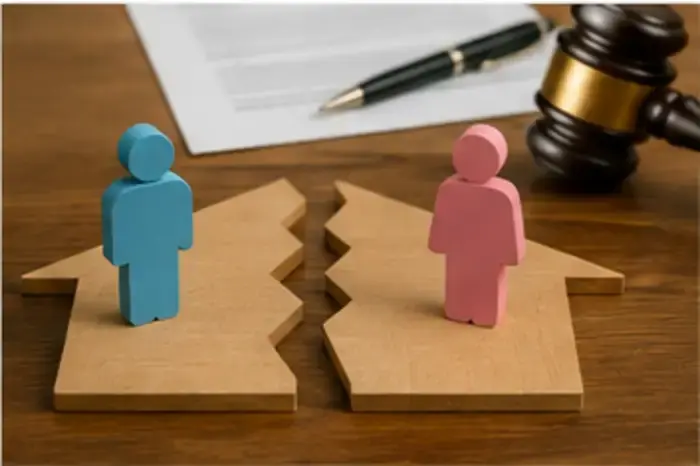
The marital home is often both a couple’s largest asset and one of their biggest monthly obligations. That makes dividing a house in divorce Utah families own less about one emotional choice and more about value, equity, affordability, mortgage liability, and the legal documents that finish the division. Utah does not automatically require every marital home to be sold, and equitable division does not mean every case ends in a simple 50/50 split. The main paths are to sell and divide the available proceeds, let one spouse keep the home through a buyout, or keep ownership together for a defined period. The best choice is the one the numbers and settlement can support after the divorce.
How Is a House Divided in a Utah Divorce?
Utah uses equitable division of marital property, meaning a fair division based on the case rather than an automatic mathematical split. A home purchased during the marriage is generally marital property even if only one spouse is on the deed, although separate property and commingling can complicate classification.
Property owned before marriage or received individually as a gift or inheritance may begin as separate property. Later use, title, payments, or commingling can affect the analysis. Dividing home equity in divorce Utah spouses negotiate should not be reduced to a simple 50/50 calculator.
Before choosing a sale or buyout, identify what portion of the property is being treated as marital, what debts attach to it, and what the settlement or court order will require.
Start With the Home Value and Real Equity
Get a Reliable Value for the House
A current value is the starting point. A house appraisal for divorce gives an independent documented opinion and can help when spouses disagree. A real estate market analysis can also estimate likely value from recent comparable sales.
How to value a house in divorce depends on the level of disagreement and the purpose of the valuation. If the parties use different appraisals or market analyses, the settlement process may need a method for choosing a value, averaging acceptable opinions, or presenting the dispute to the court.
Calculate Equity Before Calculating a Buyout
A simple starting formula for how to calculate home equity in divorce is: estimated home value minus mortgage payoff minus known property liens equals gross equity. If you are comparing a possible sale, subtract realistic selling costs as well to estimate net sale equity.
| Hypothetical equity example: If a home is worth $600,000, the mortgage payoff is $320,000, and there is a $10,000 lien, gross equity is about $270,000. If a sale would also involve $35,000 in agreed selling costs, estimated net sale equity would be about $235,000. These figures do not decide either spouse’s legal share. |
A home equity divorce calculator or divorce house buyout calculator can organize the math, but it cannot determine the legal division.
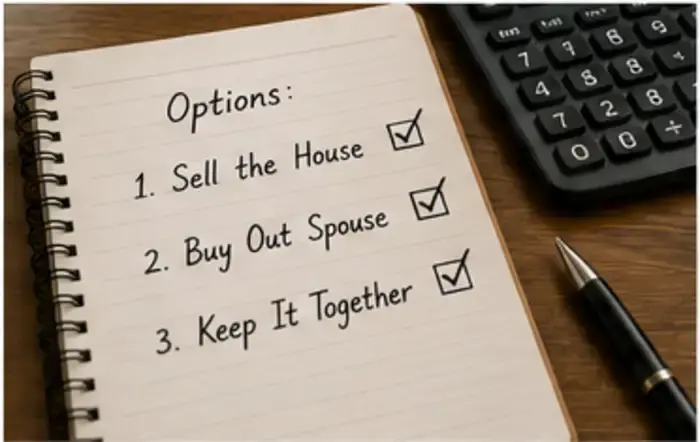
Option 1: Sell the House and Divide the Proceeds
Selling can create the cleanest financial separation when neither spouse can comfortably carry the home alone, both need access to equity, or continued joint ownership would keep too much risk between them. A sale converts the property into money that can be distributed under the agreement or court order after the mortgage, liens, and sale expenses are paid.
Sale price is not the same as divisible equity. The parties should estimate mortgage payoff, liens, brokerage or other selling costs, agreed credits, and any other obligations before discussing how much each spouse may actually receive.
If a divorce case involving property is already pending, Utah Rule of Civil Procedure 109 generally restricts either party from transferring or encumbering property without the other party’s written consent or a court order, subject to stated exceptions. That makes legal authority part of the sale plan, not an issue to solve after an offer arrives.
What If One Spouse Refuses to Sell?
One spouse should not simply sign away jointly owned property or ignore a pending court restriction. If the parties cannot agree, negotiation, mediation, or a court decision may be needed. A court ordered sale of house in divorce Utah cases can occur when the final property order calls for it, but no article can promise that a judge will order an immediate sale in every dispute.
The answer to “what if one spouse refuses to sell house in divorce” depends on ownership, the pending case, temporary orders, and the final decree. The safer step is to resolve authority before committing the property to a buyer.
Option 2: One Spouse Buys Out the Other
A house buyout means one spouse keeps the property and compensates the other for the equity share assigned in the settlement or order. A divorce house buyout Utah spouses are considering should begin with value and equity, not with half of the home’s market price.
A practical sequence is to agree on value, calculate equity, determine the transferred share, identify buyout funds, address the mortgage, complete title documents, and document the settlement. How to buy out spouse in divorce is both a property calculation and a financing decision.
| Hypothetical buyout example: Assume a home is valued at $600,000 with a $320,000 mortgage and no other liens. Gross equity is $280,000. If the spouses hypothetically agree that each receives half of that equity, the departing spouse’s share would be $140,000. That is an example only, not a Utah 50/50 rule. The real share can differ under the settlement or court order. |
Can You Afford to Keep the House After Divorce?
Run the home on one post-divorce income. Include the mortgage, property taxes, insurance, HOA fees, utilities, maintenance, major repairs, and any new financing payment.
The question “can I afford to keep the house after divorce” is different from “can I qualify for a loan.” A lender may approve financing while the monthly budget remains uncomfortable. Mortgage options during divorce Utah borrowers discuss can include refinance, and depending on the loan and servicer, an assumption or formal release of liability may also be relevant.
A Quitclaim Deed Does Not Automatically Remove Mortgage Liability
A quitclaim deed changes ownership rights in the property. It does not by itself release a borrower from the mortgage. If both spouses signed the loan, a divorce decree that assigns the debt to one spouse also does not automatically change the lender’s rights against the other borrower.
That is why “does quitclaim deed remove spouse from mortgage” should be answered no, not by itself. The retaining spouse should confirm the actual lender or servicer requirements for refinance, assumption, or a release of liability before the departing spouse relies on the deed or decree alone.
Option 3: Keep the House Together for a Defined Period
Former spouses may co-own house after divorce to preserve a child’s stability, wait for a planned sale, or allow time for financing. This can work, but it keeps both people financially tied to the asset.
Keeping house jointly after divorce requires detailed written terms. The agreement should address who occupies the home, who pays the mortgage, property taxes, insurance, utilities, HOA fees and repairs, who approves major work, what happens after a missed payment, and how future appreciation or decline is treated.
A deferred sale of marital home arrangement should also have an exit trigger. That might be a fixed sale date, refinance deadline, an agreed milestone for the youngest child, a specified buyout event, or another clear condition written into the decree. The plan should say what happens if one party wants an earlier sale or if insurance, financing, or property costs change.
Compare Selling, Buying Out, and Keeping the House Together
| Decision Factor | Sell | Buy Out | Keep Together |
| Immediate cash | Can convert equity into cash after sale costs | Departing spouse may receive buyout funds | Usually limited until later sale or buyout |
| Monthly affordability | Home payment ends after closing | Keeping spouse must carry the home alone | Payment responsibilities must be shared or allocated |
| Mortgage separation | Usually achieved when loan is paid at closing | Requires lender solution if both are borrowers | Mortgage tie commonly continues |
| Future cooperation | Usually decreases after closing | Lower once buyout and loan issues are complete | High; ongoing coordination is required |
| Main risk | Sale costs and market timing | Overestimating affordability or failing to release mortgage liability | Missed payments, disputes, and no clear exit plan |
When deciding whether to sell or keep house after divorce, the strongest option is the one that works legally and financially after the marriage ends, not simply the one that feels easiest today.
Check the Tax Consequences Before You Sign the Agreement
A qualifying property transfer between spouses or former spouses incident to divorce is generally treated differently for federal tax purposes from a sale to an outside buyer. A later third-party sale can create its own capital gains analysis.
Capital gains tax on house sale after divorce depends on the amount realized, adjusted basis, selling expenses, and any home-sale exclusion available under the facts. The federal main-home exclusion has ownership and use requirements, and special rules can apply to separated or divorced taxpayers. A home that had rental or business use can create additional issues.
If the property has substantial appreciation, prior depreciation, mixed use, or uncertain exclusion eligibility, tax advice before the timing of a sale or buyout is set can prevent an expensive surprise.
Questions to Answer Before Choosing an Option
- What is the current appraised or agreed market value?
- What is the mortgage payoff, and are there other liens?
- How much net equity would remain after a realistic sale?
- What equity share is being negotiated or ordered?
- Can either spouse both qualify for and comfortably afford the home alone?
- Will the departing spouse actually be released from mortgage liability?
- If the home stays jointly owned, what is the exact exit date or trigger?
- Are there tax issues that could materially change the net result?
Frequently Asked Questions
How do you calculate home equity in a divorce?
Start with current value and subtract the mortgage payoff and known liens. If comparing a sale, estimate selling costs too. The resulting equity figure does not automatically determine each spouse’s legal share.
How does a house buyout work in a Utah divorce?
The spouses establish a value, calculate equity, determine the share being transferred, identify how the buyout will be funded, resolve the mortgage plan, and complete title documents. The amount depends on equity and the settlement or order, not automatically half of market value.
Can a spouse force the sale of a house in a Utah divorce?
If the parties cannot agree, the divorce court can make equitable orders about property, debts, and obligations. A spouse should not bypass ownership rights or court restrictions by trying to sell alone. Whether the court orders a sale depends on the case and final order.
Does a quitclaim deed remove a spouse from the mortgage?
No, not by itself. A deed changes title ownership. Mortgage liability is controlled by the loan and lender or servicer action. Refinance, an approved assumption, or a formal release of liability may be relevant depending on the loan.
Can former spouses keep owning a house together after divorce?
Yes, if the settlement or order allows it. The agreement should clearly assign occupancy, mortgage and expense payments, repairs, future equity treatment, access to information, and a specific sale, refinance, or buyout trigger.
Final Takeaway
Dividing a house in divorce Utah homeowners own usually comes down to four questions: what the home is worth, how much real equity exists, who remains responsible for the mortgage, and what the exit plan says. Selling, a buyout, and temporary joint ownership can each work when the numbers and legal documents support the choice. Before committing to one path, compare the likely net proceeds from a sale with the true monthly and financing cost of a buyout, then make sure the settlement addresses the mortgage and title separately.