
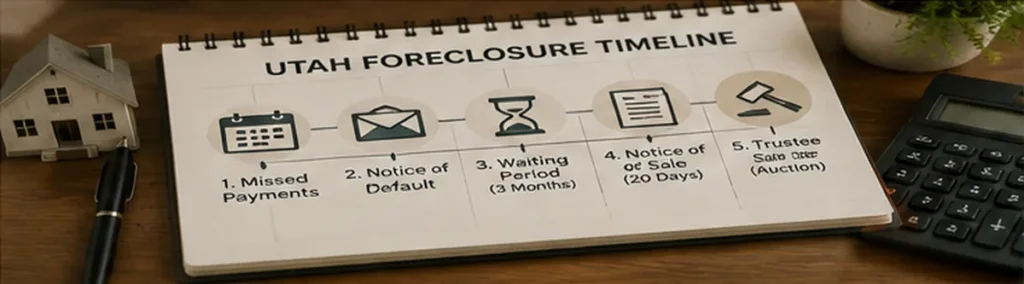
The Utah foreclosure timeline does not move directly from one missed payment to a trustee sale. For many residential loans, there is a period of delinquency and federal servicing protections before the formal state foreclosure process begins. Utah may also require a preforeclosure notice for certain owner-occupied residential loans before a notice of default is recorded. After the notice of default, state law provides additional waiting and notice periods before a public auction can take place. The exact schedule can change because of the loan type, loss-mitigation review, postponements, and the facts of the mortgage.
How the Utah Foreclosure Timeline Works
Most Utah residential foreclosures use a nonjudicial trust deed process, often called a trustee sale. Judicial foreclosure is also legally available, but the nonjudicial process is the common timeline homeowners usually see.
Timeline at a Glance
| Stage | What Happens | Timing to Watch |
| Payment delinquency | The loan becomes late and the servicer begins delinquency communication | Federal servicing rules generally limit the first foreclosure notice or filing for many covered mortgages until the loan is more than 120 days delinquent, subject to exceptions |
| Applicable preforeclosure notice | For covered owner-occupied loans, the servicer or beneficiary provides notice and a single point of contact | Cure date must be at least 30 days after the notice is sent |
| Notice of default | Trustee records the formal default and election to sell | Starts the Utah state-law waiting period |
| Reinstatement period | Eligible parties may cure the existing default | Three months after the notice of default filing in a power-of-sale foreclosure |
| Notice of trustee sale | The auction date, time, location, and property are announced | Given only after at least three months have passed from the recorded notice of default, then publication, posting, and mailing rules apply |
| Public auction | Trustee or trustees attorney sells to the highest bidder | Occurs at the time and place stated in the sale notice unless postponed |
The state process after a recorded notice of default is not the same as the full timeline from the first missed payment.
What Happens After You Miss Mortgage Payments?
A missed payment makes the mortgage delinquent, but it is not the same as receiving a formal notice of default. There is no single fixed number of missed payments that applies to every Utah mortgage. Federal rules and loan circumstances can change when formal foreclosure activity begins.
For many covered residential mortgages, federal servicing rules generally prevent the first foreclosure notice or filing until the borrower is more than 120 days delinquent. This 120 day foreclosure rule is a general servicing protection, not a guarantee that every loan follows exactly the same schedule.
Do not convert 120 days into a promised number of missed monthly payments. The delinquency date, loan type, and legal exceptions can affect the result. Ask the servicer for the current delinquency amount and foreclosure status.
The Preforeclosure Notice Before a Utah Notice of Default
Utah has a specific preforeclosure notice requirement that can apply to certain owner-occupied residential loans held by a qualifying financial institution. For a covered loan, the beneficiary or servicer must designate a single point of contact and send written notice of the intent to file a notice of default before the formal notice is recorded.
The notice must give a cure date that is not fewer than 30 days after the notice is sent. It should identify the default, provide an itemized amount needed to cure it, and give contact information for the single point of contact. This stage gives the homeowner time to confirm the amount due and discuss foreclosure relief.
Because the rule has a defined scope, not every loan receives the same form. Keep copies of all servicer notices.
What Is a Notice of Default in Utah?
A notice of default is the recorded document that formally starts the Utah trust deed foreclosure sequence. The trustee records it with the county recorder where the property is located. It identifies the trust deed, describes the property, states that a breach has occurred, describes the breach, and states the election to sell the property to satisfy the secured obligation.
What Happens After a Notice of Default?
After the notice of default is recorded, at least three months must pass before the trustee gives the notice of sale. During this period, an eligible borrower or other qualifying party may have the right to cure the existing default under Utah reinstatement rules.
Notice of Default vs. Notice of Sale
The notice of default and notice of trustee sale are not the same document. The notice of default comes first and records the breach and election to sell. The notice of trustee sale comes later and announces the scheduled auction date, time, and place. This difference is important when calculating a notice of default foreclosure timeline.
The Three Month Reinstatement Period
Utah law provides a three-month reinstatement period after the notice of default filing when the power of sale is being exercised. During that period, eligible parties can cure the existing default by paying the amount then due along with permitted enforcement costs, trustee fees, and attorney fees. The law does not require payment of principal that would not have been due if the default had not occurred.
Curing the default reinstates the obligation as though the acceleration had not occurred. Paying the correct reinstatement amount within the allowed period can stop the current foreclosure sequence.
Do not wait until the final day to request the amount. Servicers and trustees need time to prepare figures and process funds. Ask early for the reinstatement deadline and payment instructions in writing.
Notice of Trustee Sale and Utah Sale Notice Rules
After the required period following the notice of default, the trustee can move to the notice of trustee sale. This notice tells the homeowner and the public when and where the property is scheduled for auction. It includes the sale date, sale time, sale location, a description of the property, the current beneficiary, and the record owners.
What the Notice of Trustee Sale Tells You
Confirm the scheduled date, trustee contact information, and whether any postponement has been announced. Do not rely only on a verbal estimate.
How the Sale Notice Must Be Given
Utah requires several forms of sale notice. Newspaper publication must occur at least three times, at least once a week for three consecutive weeks, with the final publication at least 10 but not more than 30 days before the scheduled sale. Utah also requires notice under the applicable public-notice rules for 30 days before the sale and posting at least 20 days before the sale. Mailing requirements can also apply at least 20 days before the auction to qualifying people entitled to notice.
These notice rules are not extra grace periods. Use the scheduled sale date in the valid notice for urgent decisions.
What Is a Trustee Sale in Utah?
A trustee sale is the public auction used to complete a nonjudicial trust deed foreclosure. The trustee or the trustees attorney conducts the auction and sells the property to the highest bidder. The sale must occur at the time and place stated in the notice unless it has been properly postponed.
How the Public Auction Works
Utah law provides for the sale at a courthouse serving the county, with the auction time between 8 a.m. and 5 p.m. The successful bidder must meet the payment requirements stated for the sale. The lender or beneficiary may also bid as allowed by law.
After a completed nonjudicial trustee sale, the trustees deed transfers the property, and Utah law does not provide a post-sale right of redemption under this trust deed process. That makes the period before auction important for reinstatement, payoff, loss mitigation, or legal review.
Can a Trustee Sale Be Postponed in Utah?
Yes. The person conducting the sale can postpone it by publicly announcing the postponement at the last appointed time and place. If the postponement extends more than 45 days after the original sale date, the sale must be noticed again in the same manner as the original sale.
A sale may also be postponed during foreclosure-relief discussions. Do not assume an application automatically delays the auction; confirm any postponement with the trustee or servicer.
Options Before the Trustee Sale
- Reinstatement or cure: request the exact reinstatement amount and deadline and determine whether the default can be cured within the available period.
- Loss mitigation: contact the mortgage servicer promptly about any available modification or other foreclosure-relief option.
- Payoff or sale: paying off the secured debt before the completed trustee sale can resolve the foreclosure, but merely listing the property for sale does not automatically stop the auction.
- Legal review: obtain prompt Utah foreclosure counsel when there is a dispute about notices, bankruptcy, loan servicing, ownership, or an imminent sale date.
The best option depends on time remaining, the reinstatement or payoff amount, home equity, and available relief. Keep communication documented and focus on the next deadline.

FAQs About the Utah Foreclosure Timeline
How many missed payments before foreclosure in Utah?
There is no universal missed-payment count for every mortgage. For many covered residential loans, federal servicing rules generally prevent the first foreclosure notice or filing until the borrower is more than 120 days delinquent, subject to exceptions.
How long does foreclosure take in Utah?
The full timeline from the first delinquency varies. After a Utah notice of default is recorded in a nonjudicial trust deed foreclosure, at least three months must pass before notice of sale is given, followed by the required sale-notice process.
How long after a notice of default is the foreclosure sale?
The notice of trustee sale cannot be given until at least three months after the notice of default is recorded. The auction then follows Utah publication, posting, mailing, and scheduling requirements, so the final sale occurs later than the three-month mark.
What is the difference between a notice of default and a notice of sale?
The notice of default records the breach and the trustees election to sell. The notice of trustee sale comes later and announces the actual date, time, location, and property details for the public auction.
Can a trustee sale be postponed in Utah?
Yes. The sale can be postponed by public declaration at the appointed time and place. If the delay extends more than 45 days after the original sale date, the sale must be noticed again.
Know Your Next Foreclosure Deadline
The Utah foreclosure timeline is easiest to manage when you track the recorded notice of default date, the reinstatement deadline, the scheduled trustee sale date, and the status of any loss-mitigation review. Confirm those dates with the servicer or trustee instead of relying on estimates. If selling the property is part of your plan, remember that a listing alone does not stop a scheduled sale. Act early enough for the payoff and closing to happen before the auction.
This article provides general information, not legal advice. Foreclosure timing can change because of loan type, federal servicing rules, loss mitigation, bankruptcy, postponements, and the facts of the individual mortgage.