
Yes. You can often sell property with an access easement in Oregon, including a rural home or acreage reached by a neighbor’s private road. The essential question is whether the property has a legally enforceable right of access that a buyer can rely on. A visible driveway or years of friendly neighbor cooperation is not, by itself, proof of that right.
Before listing, establish where the road runs, who can use it, whether the easement benefits future owners, and who maintains the surface. Those details affect title review, buyer financing, price negotiations and the practical use of the land. A sale may still be possible where records are unclear, but the uncertainty should be addressed before a buyer discovers it during closing.
Can You Sell Oregon Land That Uses a Neighbor’s Private Road?
Generally, yes. A private road crossing someone else’s parcel can provide legitimate access to a rural property. What matters is the legal arrangement supporting the crossing, rather than who paved or graded the road. Buyers will want evidence that the route connects to a public road and can be used for the activities they intend.
An Access Easement Is Not the Same as Owning the Road
An access easement gives a defined right to use land owned by someone else, commonly for passage to and from a property. The land benefiting from a typical appurtenant easement is called the dominant parcel; the land crossed is the servient parcel. The servient owner ordinarily retains the underlying land, subject to the granted rights. Neither party should assume the easement permits unlimited road widening, commercial traffic or utility work.
A private ingress-and-egress easement is also different from a utility easement or public right-of-way. Permission to install electric lines does not automatically grant residential driveway access. The actual recorded language and relevant land history control the analysis.
Four Access Situations a Seller Must Distinguish
| Access status | Buyer concern | Best next action |
| Recorded appurtenant easement | Confirm the route, scope and continued benefit | Match the instrument to deeds, survey and title report |
| Written but unrecorded grant | Enforceability and notice to later owners may be disputed | Have counsel assess recording and title protection |
| Neighbor’s informal permission | Use may be revocable; financing can be difficult | Seek a properly drafted, recorded access agreement |
| No established legal access | Buyer may lack enforceable vehicle access | Investigate title history and potential legal remedies |
None of these descriptions alone establishes that a particular transaction will close. A title insurer or lender may request more documentation even when the roadway has worked without conflict for decades.
How to Verify Deeded Access Before Listing
Search the Deed, Title Report and County Recordings
Start with the current deed and full legal description. An easement may be created in an earlier deed, a separate recorded grant, a partition document, or a recorded subdivision plat. Search the county recording history for both the parcel you are selling and the adjoining parcel carrying the route. Ask a title company for a preliminary title report and copies of the referenced documents.
Do not rely only on assessor maps or online parcel boundaries. Their lines can be useful leads, but they do not replace the easement grant or a survey. If the instrument uses an old description, ask a surveyor or Oregon real-estate attorney to connect that description to the road on the ground.
Check Road Location, Permitted Uses and Maintenance Terms
Read for the width and location of the route, vehicle permissions, gate restrictions, repair rights, drainage work and whether road upgrades require consent. A grant for farm access may need closer interpretation before a buyer assumes it authorizes a new residential subdivision or heavy construction vehicles. Even lawful access can be physically unsuitable for emergency vehicles or year-round driving.
Review whether road maintenance is addressed in a recorded document or separate agreement. Ask who pays for gravel, grading, culverts, drainage and storm damage. If neighbors have been paying informally, record the history accurately without describing it as a binding agreement unless the documents support that conclusion.
Seller Document Checklist for an Oregon Access Easement
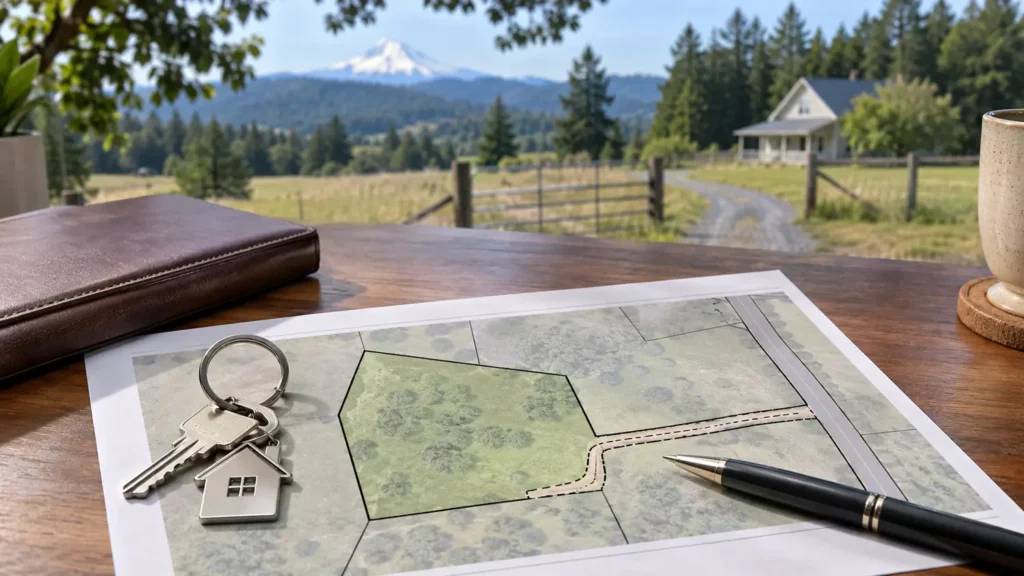
- Current deed, earlier deeds and the document granting access.
- Recorded plat or survey identifying the easement route and public-road connection.
- Preliminary title report and copies of any listed exceptions.
- Private-road maintenance agreement and relevant payment receipts.
- Written neighbor correspondence, dispute notices, gate arrangements and repair history.
- Road photographs, seasonal-access observations and any professional assessments.
Put these records in one package for prospective buyers and the closing team. Early documentation reduces the chance that the same access question must be answered repeatedly during inspections, appraisal and underwriting.
Does an Access Easement Transfer When Oregon Property Is Sold?
Appurtenant Rights Versus Personal Easement Rights
An easement appurtenant ordinarily benefits a particular parcel and continues with that land when ownership changes, subject to the governing document and applicable law. An easement in gross instead benefits a person or entity rather than a particular parcel; transferability can depend on the nature and wording of the right. Sellers should not promise that every access arrangement automatically transfers.
Review the original grant, its beneficiaries, any term or termination provision, amendments and the current title commitment. If the history is unclear, ask counsel to determine whether the right remains effective and whether a corrective document is needed before closing.
What if Access Is Unrecorded or Only a Handshake Deal?
A buyer may hesitate when the seller can drive across a neighbor’s land but cannot produce an enforceable grant. An unrecorded agreement can present questions about successor owners and title insurance. A neighbor’s informal permission may be especially vulnerable if relationships change. The cleanest practical resolution may be a negotiated written easement that is properly signed and recorded, although the neighbor is not obligated to agree.
Long use alone should not be described as proof of a prescriptive easement. Oregon courts evaluate specific legal elements, including adversity; regular travel on an existing road does not automatically establish those elements. Have an attorney review the actual evidence before making a claim to a buyer.
Selling Landlocked Oregon Property Without Recorded Road Access
Landlocked property may still be saleable, but the absence of enforceable vehicle access creates substantial uncertainty. A purchaser might consider the land for limited uses, while another might need a road suitable for residence, construction or forestry. Marketing should describe the known access status precisely rather than promise a future route.
Permission, Implied Easements and Prescriptive Claims
Depending on the chain of title and historical use, an attorney may evaluate an implied easement, a claimed prescriptive right or other legal theories. Those rights depend on evidence and the relevant legal test. A road appearing on old maps, or a prior owner crossing a neighbor’s pasture, is not enough by itself to confirm the outcome. Litigation can be costly and uncertain.
Could Oregon’s Statutory Way of Necessity Help?
Oregon has a statutory process under ORS 376.150–376.200 for certain qualifying routes to otherwise inaccessible property. It involves a petition and county procedures, with conditions and limitations. A landowner does not receive a route automatically merely because the parcel has no road. For example, statutory restrictions address existing enforceable access, alternative legal remedies and certain owner-created access problems.
Ask an Oregon land-use or real-estate attorney to evaluate whether the statute could apply, which county body has jurisdiction, likely expenses and whether the proposed route is realistic. Do not advertise a speculative way of necessity as if it had already been established.
What to Do if a Neighbor Denies Access
Keep a written record of the obstruction and any past agreements, but avoid removing gates, crossing other land or escalating the dispute yourself. Ask a title professional and attorney to check the deed, precise route and available remedies. If an agreement is possible, resolve it in writing before committing to a closing date. Coordinate any showings so that neither seller nor buyer trespasses while the issue is being reviewed.
Private Road Maintenance, Gates and Shared Access Costs
Oregon Rules on Upkeep and Cost Sharing
Under ORS 105.175, holders of interests in an easement are responsible for keeping it in repair. A maintenance agreement or provisions in the recorded easement instrument control how the costs are divided. In the absence of both, the statute generally allocates costs among easement-interest holders in proportion to use, with relevant considerations that can include vehicle frequency and weight.
Do not assume every home pays an equal share or that a seller can impose a new split by announcement. The rights and duties of the actual parties matter. Give buyers the written arrangement and any outstanding repair assessments or disputed invoices before the contract becomes final.
Restrictions That May Concern a Buyer
A buyer may need year-round access for school transportation, deliveries, emergency vehicles or building work. Check gates, road width, turning space, grades, seasonal mud, snow, damaged bridges and culverts. A legally valid easement does not itself guarantee the route meets fire, planning or lender requirements for a buyer’s intended use. Separate legal access from the cost of improving the road.
Does an Access Easement Affect Rural Property Value or Buyer Financing?
Which Access Defects Affect Buyer Confidence?
A clearly recorded easement with a usable road and predictable maintenance terms is usually easier for buyers to evaluate than informal permission across a neighbor’s parcel. Missing documents, unresolved boundary disputes, expensive road repairs and narrow use restrictions can reduce interest or lead to contingencies. There is no reliable universal percentage by which an easement changes value; a local appraiser and comparable sales offer a better starting point.
Cash Buyer Versus Traditional Listing
| Sale route | Potential benefit | Important limitation |
| Traditional listing | Exposure to multiple buyers and possible competing offers | Financing, title and appraisal concerns may narrow the pool |
| Direct cash or investor offer | Potentially fewer lender-driven contingencies | Buyer still needs lawful access and acceptable title |
| Resolve access first, then market | May broaden buyer confidence and clarify value | Negotiation, survey and legal work may take time |
Compare written offers on net proceeds, required repairs, title exceptions and deadlines. A cash purchaser can accept some risks that a lender might not, but payment method cannot create an easement that does not exist.
Oregon Disclosure Duties and the Steps to Close the Sale
Disclose Access Restrictions and Shared-Maintenance Agreements
Oregon’s seller property disclosure form under ORS 105.464 asks about rights of way, easements, licenses, access limitations and agreements for joint maintenance. Disclosure requirements depend on the property and transaction type, and statutory exclusions can apply. The form is not a substitute for a title search. Provide accurate answers based on known facts and avoid describing disputed rights as settled.
Land-only transactions and certain fiduciary transfers can require a different analysis. Ask the agent or closing attorney which disclosures apply rather than assuming the same residential form governs every rural acreage sale. If a neighbor has challenged the road, disclose the dispute and provide the correspondence or order available.
Six-Step Seller Process
- Gather the current deed, easement grants, prior surveys and a preliminary title report.
- Classify the route as recorded appurtenant access, an unrecorded claim, permission or no established right.
- Confirm the surveyed location, road connection and whether the grant covers intended vehicles and uses.
- Organize road maintenance responsibilities, expenses, gate rules and any neighbor disputes.
- Choose a listing or direct-offer strategy using a realistic condition and title assessment.
- Have the closing team confirm title insurance, buyer financing, deed language and unresolved conditions before settlement.
A Sample Rural-Property Scenario
Consider a hypothetical Oregon home reached by a gravel driveway over a neighboring parcel. The recorded easement grants residential vehicle access, but the neighbors never signed a separate maintenance agreement. The seller can produce the grant and survey, then ask counsel to review ORS 105.175 and any recorded repair provisions. A buyer may still request evidence about road condition or lender acceptance.
Now consider the same driveway used only with a neighbor’s verbal permission. The physical road is identical, yet legal certainty is much lower. The seller might negotiate a recorded easement or accept a carefully disclosed conditional offer. The contrast shows why photographs of a driveway do not answer title questions.
Frequently Asked Questions
Is It Hard to Sell a House With an Easement in Oregon?
Not necessarily. A well-documented access easement can be an ordinary feature of rural property. Challenges increase when the route is disputed, the permitted uses are unclear or repairs are expensive. Buyers generally want to see the recorded grant and a usable road, and lenders or title insurers may seek additional assurances.
Can a Neighbor Deny Access to a Recorded Easement?
A neighboring owner cannot simply erase enforceable easement rights by objecting. However, the document determines where and how access may be exercised, and disagreements about gates or excessive use can occur. Avoid self-help measures. Have an Oregon attorney interpret the grant and advise on a documented, lawful response.
Who Owns the Land Under an Access Easement?
Usually the owner of the servient parcel holds title to the underlying land. The dominant parcel has a defined right to use it for the permitted access purpose. This arrangement does not transfer ownership of the road corridor to the easement beneficiary. Check the deed and survey for the particular parcels.
Who Is the Dominant Owner in an Easement?
The dominant owner is the person who owns the parcel benefited by an appurtenant easement. For example, when a rural house uses a neighbor’s driveway under a recorded grant, the house lot may be the dominant parcel. The neighboring land crossed by the route is the servient parcel.
How Much Does an Easement Devalue Rural Oregon Property?
There is no fixed statewide percentage. A secure, recorded driveway easement may make land usable, while a poorly defined right or damaged road may discourage buyers. The effect depends on comparable sales, allowed uses, improvement costs and access disputes. A local appraisal is more defensible than applying a generic discount.
Can I Put a Fence or Gate Across an Access Easement?
That depends on the easement wording, actual road use and whether the structure unreasonably interferes with the beneficiary’s rights. Some agreements address gates directly. Do not install or remove a barrier based solely on ownership of the underlying land. Review the recorded document and obtain legal advice for a contested access route.
Who Pays Property Taxes on an Easement?
An easement does not create one universal, separate property-tax bill. The landowner and benefited property owners may have different assessed interests, while road maintenance cost sharing is a separate issue. Review the county tax records and specific agreement rather than treating the maintenance payments as property taxes.
Final Checklist Before Selling
Confirm that the road reaches a public route, identify the legally granted access, match the grant to the actual driveway, and verify what the buyer may do with it. Gather title records, maintenance documents and dispute history. Evaluate whether the road itself needs work, and compare offers using financing conditions, closing costs and likely net proceeds.
The Takeaway
You can sell rural Oregon property with an access easement when the buyer understands the rights being conveyed and the closing team can verify title. A recorded right, a passable road and a clear maintenance arrangement make that conversation easier. Where any of those pieces is missing, address the uncertainty directly before promising access or a closing date.
If you are weighing a traditional listing against an as-is offer, request a property-specific review after gathering the documents. A local title professional and Oregon real-estate attorney can help resolve access questions that marketing alone cannot fix.